Is wine good for you?

Is wine good for you?In moderation and as part of an overall healthy diet, the short answer is yes! Thanks to its alcohol content and

Foods That Burn Fat

Let`s do away with the misconception that there are foods that contain no calories at all. The fact is that every food type contains

Arnold Schwarzenegger’s Bodybuilding Workout

Arnold Schwarzenegger was certainly the greatest bodybuilder of his time, and will be remembered as one of the greatest bodybuilders of the 20th Century. His movie career has

Foods that will Increase your Studying Effectiveness

Here’s some food for thought: what you eat can affect how well you study. It’s true; a diet rich in essential fatty acids, fruits and vegetables does wonders for your brain power. Don’t worry, pizza counts, as long as you make it whole grain and top it with lots of colorful vegetables and cheese. Check out our list of 20 foods that can help you boost memory and study more effectively.

A healthy sex life: 10 reasons to make love

Evidence points to the many health benefits of an active sex life. Sex Made Easy

The Sweet Truth About Chocolate and Your Heart

While not a question normally asked at a social gathering, flavonoids have become quite a hot topic in the media and in scientific journal

Showing posts with label Workout. Show all posts

Aug 4, 2011

Lose the final 10 Pounds!

Rotating your traning methods will help your body break through a plateau .
No matter how much weight you lose , most of us get stuck just as our target weight is within sight.


1. Combine
Combine two exercise for two different body parts,
such as a lunge and an overhead press, into one move

2. Density Instead of aiming for a number if reps do as many reps as you can during a 30- to 45- seconds-long set. Try to do more reps the next workout.
pushup or chinups work well here.

3. Maxing out Toss in a couple of "heavy days" and use a weight that you can only lift four to six times.If you can perform more than seven reps on a set,go heavier.

4. Putting it all to work
For each strategy ,set up two to three circuits of four exercises.
Including a pushing exercise (e.g. bench press) a pulling exercise (cable rows), a leg movement (e.g. squats) and something for your abs(e.g.bicycle crunches).
Rest as little as possible between each exercise, plus 30 to 60 seconds after each circuits. you can train three or four days per week , but use a different strategy each day

By RISHABH JAIN with

Jul 22, 2011

How to Deal with and Heal Back Pain

“The back represents our support system.  Problems with the back usually mean we feel we are not being supported.  Too often we think we are only supported by our job or by our family or spouses.  In reality we are totally supported by the universe, by Life itself.” – Louise Hay

Healing Back Pain Through Yoga,  Exercise and Diet


If you are suffering from general back pain you’ve come to the right page.  For years I was such a tough athlete.  A gymnast and a swimmer for years.  And then three rear- enders later I lived incessantly with muscles spasms, aches and pain for many years thereafter.  I was a gymaholic.  I guess there are worst things to be.  But I still had that nagging pain.  I went to doctors, chiropractors, had scans, x-rays, the works.  No one really found much of anything except that my hips are uneven and when they get out of whack, it causes pain on one side or the other.  Simple adjustment and it goes away.  As I get older though, I have noticed the nag increase.  I have taken it upon myself, as I do not want to live in pain the rest of my life, to incorporate some healthy habits that have changed the course of this nagging pain.  And guess what?  When I follow them, the pain dissipates.  I hardly feel it anymore, if at all.  Just sharing what works for me.  Take it or leave it. Here they are:

Yoga is Fantastic for Healing Back Pain


When I first started my yoga teacher training, I had serious trouble with my back.  I didn’t even know whether I was going to make it through the series because I had such a hard time sitting.  I was in absolute agony the first few weeks begging for relief.  But here’s what happened.  I learned so many beautiful poses.  Poses that helped me regain my flexibility I thought I had lost.  Poses that stretched my limbs and tendons.  Poses that strengthened my legs, core, back and arms, like Plank Pose and Side Plank.  Poses that soothed not only my back, but my soul.  Child’s Pose, Pelvic Tilts, Cobra Pose, Seated Twists as well as poses using bolsters, blocks and straps to support my body. I also made friends with people who were much further along the healing path and who helped me understand some of the emotional causes for back pain as well.  Mine was all lower back pain.  After taking the suggestion of one of my new found friends, I read Louise Hayes, .You Can Heal Your Life.  I realized my back pain had a lot to do with my financial collapse at the time as well as years and years of never feeling like there was enough money to support me. It is so difficult to function in daily life when you are in pain.  It is difficult to be quiet or to be peaceful when your body is screaming at you for relief.  Practicing yoga consistently and educating yourself on the causes of back pain keeps you out of back pain trouble.  When I don’t practice consistently, it creeps back and definitely lets me know I need to stay on top of things and get back in the groove.

Yoga Makes You Aware of What you Put in Your Body


Yoga and meditation, in a nutshell, is about becoming aware.  I used to eat red meat almost every day with, I might add, a mighty glass or two of red wine to wash it down.  In fact, I used to eat a lot of inflammatory foods, but thanks to my practice I no longer crave those types of foods and do not eat them. I no longer mindlessly put junk into my body. And what do you think happened when I stopped eating foods that made my body hurt?  Less inflammation in my body, giving it the ability to recover from a challenging workout.  Soda, sugar, dairy products, fried food and processed food all contribute to inflammatory conditions.  Inflammation makes your body hurt.  So check in with yourself and clean it up.  No one wants to live in pain.  So the next time you’re ready to pick up a bag of chips, burn it (just kidding…trash it) and pick up some almonds, fruit or crunchy veggies instead.  Make it your business to change your unhealthy eating habits.  If you are one of those people who says, “Oh, one bag won’t hurt.”  Think again.  Chips cause decay and pain.  Change your habits and your body will thank you over and over again for the rest of your life.  If you don’t believe me, read
Younger Next Year by Crowley and Lodge.  You won’t be disappointed. You will begin to feel better before you know it.  Add another component and you will feel better yet.  You see, it’s not just about the food.  The food is only one factor.  Exercise is another key ingredient to healing back pain.

Strengthen Your Back and Get Rid of the Fat


Extra weight is either adding to your back pain or is the root cause of the pain.  In fact, obesity is the leading cause of back pain today.  All that extra weight around your middle causes strain on your back, your vital organs and your joints.  It has the ability to throw off your balance making it hard to function properly.  If you’re one of those people who says, “Well, I only have a little bit.”  You’re not so different.  Get it off.  You have got to start burning the fat off with exercise and getting your heart rate up for at least twenty minutes per day.  Yes, that means breathing hard and a little soreness if your not used to working out.  Start and don’t stop.  Don’t stop. Ever.  If you start and then stop, you will only accelerate the decay process already going on in your body like diabetes, high blood pressure, arthritis and a host of other undesirables. If you keep going each day, your cells will begin to replenish and rebuild.  You may not feel great tomorrow or even next week.  But in 2-4 weeks you will feel significantly better. Just 30-60 minutes per day folks, 6 times per week.  Find something you like and give it all you’ve got.  Shed that unwanted, drag me down, fat that has your heart screaming “Get off me or I’m gonna shut down!”  And be done with it for life.  If you are new to working out or you are limited on time, I have a great suggestion.This program is actually awesome for anyone but particularly useful when it comes to time management. It comes with an excellent nutrition guide. It works. 10 minutes. 20 Minutes if you like. Do it. You will be on your way in no time. CLICK HERE

Maintenance and Preventative Care for Your Back


Good chiropractic care is underrated.  I have found that is is crucial to maintaining good back health.  Notice I didn’t say mediocre chiropractic care.  You need to go to someone who understands your body and your issues.  Someone who will spend the time working on adjustments that are the right adjustments for you and does not give up until he/she has it figured out.  Period.  My chiropractor is awesome.  He rolls me into the adjustment. Never pushes too hard and never does anything that would make the inflammation worse. I get a wonderful massage while I’m there just for the places that are causing me pain.  I am treated well and their concern for my well-being is present every time I visit. Definitely not a “wham bam thank you ma’am” kind of place where you hurdled in like cattle on speed and out in 5 minutes. And I’ll say the same thing about massage therapists.  Sometimes you’ve got to kiss a few frogs before you find your prince or princess.  I have one in my area I would refer anyone to.  He is intuitive and seems to know exactly what I need every time I visit.  All I have to do is tell them where it hurts.  He gets it.  If you want to have an exceptional massage you have got to be willing to communicate.  Don’t be shy.  They are there to help you, but if they don’t know what is bothering you, their job then becomes a guessing game.  Who wants that?  You pay $70-100 bucks to let them guess? “Oh, surprise me.  Let’s see if you get it right.”  No!  Tell them.  Give them as much information as you can.  Let them do their thing and give yourself a delicious treat

By RISHABH JAIN with

Jul 16, 2011

Arnold Schwarzenegger’s Bodybuilding Workout

Arnold Schwarzenegger’s Bodybuilding Workout


Arnold Schwarzenegger was certainly the greatest bodybuilder of his time, and will be remembered as one of the greatest bodybuilders of the 20th Century. His movie career has immortalized his body in a way that no other world class bodybuilder has accomplished. He won the Mr. Olympia 6 years running from 1970, beating Franco Columbu (who Sly Stallone employed for his training) in his final contest of 1975.

The following weight training routine is one that Arnold Schwarzenegger used later in his career. It is typical of the training style that Arnold Schwarzenegger preferred, i.e. many sets, lots of work, lots of time in the gym.

1. Arnold Schwarzenegger Chest Exercises:

Bench press – 5 sets, 6-10 reps;
Flat bench flies – 5 sets, 6-10 reps;
Incline bench press – 6 sets, 6-10 reps;
Cable crossovers – 6 sets, 10-12 reps, Dips – 5 sets, to failure;
Dumbbell pullovers – 5 sets, 10-12 reps.
2. Arnold Schwarzenegger’s Back Exercise:

Front wide-grip chin-ups – 6 sets, to failure;
T-bar rows – 5 sets, 6-10 reps;
Seated cable rows – 6 sets, 6-10 reps;
One-arm dumbbell rows – 5 sets, 6-10 reps;
Straight-leg deadlifts – 6 sets, 15 reps.
3. Arnold Schwarzenegger’s Legs:

Squats – 6 sets, 8-12 reps;
Leg presses – 6 sets, 8-12 reps;
Leg extensions – 6 sets, 12-15 reps;
Leg curls – 6 sets, 10-12 reps;
Barbell lunges – 5 sets, 15 reps.
4. Arnold Schwarzenegger Calves:

Standing calf raises -10 sets, 10 reps;
Seated calf raises – 8 sets, 15 reps;
One-legged calf raises (holding dumbbells) – 6 sets,12 reps.
5. Arnold Schwarzenegger Forearms:

Wrist curls (forearms on knees) – 4 sets, 10 reps;
Reverse barbell curls – 4 sets, 8 reps;
Wrist roller machine – to failure.
6. Arnold Schwarzenegger Biceps Workout:

Barbell curls – 6 sets, 6-10 reps;
Seated dumbbell curls – 6 sets, 6-10 reps;
Dumbbell concentration curls – 6 sets, 6-10 reps.
7. Arnold Schwarzenegger Triceps Exercises:

Close-grip bench presses (for the all three heads) – 6 sets, 6-10 reps;
Pushdowns (exterior head) – 6 sets, 6-10 reps ;
Barbell French presses (interior head) – 6 sets, 6-10 reps ;
One-arm dumbbell triceps extensions (exterior head) – 6 sets, 6-10 reps.
8. Arnold Schwarzenegger Shoulder Training:

Seated barbell presses – 6 sets, 6-10 reps;
Lateral raises (standing) – 6 sets, 6-10 reps;
Rear-delt lateral raises – 5 sets, 6-10 reps ;
Cable lateral raises – 5 sets, 10-12 reps.
Arnold Schwarzenegger Bodybuilding Training Video

This video montage shows Arnold training in a gym prior to a major bodybuilding competition. You get a feel for the sheer brute force and immense effort he put into all his exercises. Anyone that says he did volume training and did not work to intensity has obviously never seem him do a T-bar row.


Your can also read about Arnold’s weekly bodybuilding routine. For more authoritative information on Arnold Schwarzenegger workouts, we recommend that you purchase one of his many books on weight training – Arnold Schwarzenegger workout books from Amazon.com

By RISHABH JAIN with

Myth of workouts


Myth No. 1:
Exercise is supposed to be miserable
Reality: Exercise should be pleasurable and fun. The trick is to find workouts that challenge you but that you also enjoy. If you love playing tennis or soccer or beach volleyball with friends or going bike riding with your hubby or making those coins on your hip scarf jingle in bellydance class or the calm and peaceful feeling you get after a good yoga session, then you’ll get a great workout and have fun at the same time.

Myth No. 2:
 High impact exercise is better than low impact
Reality: High impact is no more and no less better than low impact exercise. While, in some cases, high impact exercise might burn more calories (i.e. running versus walking), in other instances that is not the case. High impact exercise is also harder on the joints. You can get a killer low impact workout. Think Tae Bo or Zumba, for example.

Myth No. 3:
 You need to exercise for hours each day to see any benefit from exercise
Reality: You can see major health benefits from working out a lot less than that. I was recently diagnosed with having a borderline high cholesterol count. When I asked what I could do to bring it down, I was told to do cardio exercise for 45 minutes three times a week.

Myth No. 4:
 You need to work out in a gym to benefit from exercise
Reality: As long as you get moving, it doesn’t matter where you are. You can work out in the gym, on the street (biking, walking, jogging), in your home (the WII Fit, home exercise equipment or video exercise), at a park (playing ball, swimming, biking or jogging), or on the beach (yoga class, beach volleyball). As long as you move, you’ll lose (weight that is).

Myth No. 5:
 You need to focus on doing cardiovascular exercise if you want to lose weight
Reality: Muscle is more metabolically active than fat so it burns more calories. More importantly, women need toned muscles to help prevent osteoporosis. Plus, muscle has shape – fat doesn’t. So, to achieve the body you want, you will need a combination of cardio and weight toning exercises. I recommend cardio in the morning and toning exercises at night.

Myth No. 6:
 Women should avoid doing weightlifting exercises because they will create bulky muscles
Reality: If you use light weights with lots of repetitions, you won’t get bulky muscles. Instead, you’ll get long, lean muscles. Think sexy arms and lean toned legs. I’m still working on those.

Myth No. 7:
 Weightlifting exercises will make you heavier because muscle weighs more than fat
Reality: Muscle doesn’t weigh more than fat. A pound of muscle weighs the same as a pound of fat. Muscle is more dense than fat though, so a pound of muscle takes up less space than a pound of fat.

Myth No. 8:
 You don’t have time to exercise
Reality: Yes you do. We make time for the things we really want to do. You might have to get up 30 minutes earlier in the morning or turn off that television at night or get off the Internet/Facebook/blog and turn off the phone for a few minutes, but you have time to exercise. On those days that I am really pressed for time, I do one of Leslie Sansone’s one mile workouts for 15-20 minutes. It gives me a good start to the day.

By RISHABH JAIN with

Jul 15, 2011

High Intensity Strength Training


If you’re getting bored with your normal strength training routine, or if you’re not getting the results you’re looking for, think about trying HIT: High Intensity Training.

HIT is a specialized approach to strength training that was originally developed in the 1970’s by trainers and coaches who worked with professional athletes in various sports. Compared to traditional forms of strength training, evidence suggests that HIT provides better results; requires less time in the gym; and has a lower risk of injury and overuse problems.

These perks make HIT suitable for many people, including non-athletes and those simply trying to lose weight and become more fit, regardless of age or gender.

First, a General Caution
As with any form of high intensity exercise, you need to be in good basic health and free from any significant cardiovascular risk factors and muscle/joint problems that could limit your capacity to exercise safely at a high intensity level. If you have any doubts or concerns along these lines, you need to consult your doctor before trying any of these techniques. HIT is demanding—both physically and mentally.

Principles of HIT
So, how exactly does HIT differ from "traditional" strength training? There are two primary differences.

1. The Perfect Form Principle
While traditional training methods focus on total number of repetitions (8-15), sets (2-3), and weight lifted, HIT focuses on the quality of each repetition and set. By using ideal form, you can achieve better and faster improvements in strength and muscle growth with just one set of exercises for each muscle. Proper form and fewer sets virtually eliminate many of the injury risks associated with multiple sets that are performed with less than ideal form. The basic characteristics of a “perfect” HIT repetition/set include:
Slow, controlled movement. Without bouncing and without using momentum, take 2-3 full seconds to lift the weight (positive phase). Before lowering the weight, pause for half a second and "squeeze" the contracted muscle. Finish one rep by taking 4-5 full seconds to lower the weight to the starting position (negative phase). The key here is to keep the muscle under constant tension, without allowing the weight to rest on the machine or your body at the bottom of the negative phase.
Full range of motion. Each exercise should be taken through the complete range of joint movement, but don't fully straighten or “lock out” your joints.
Momentary muscle fatigue (MMF). You want to "feel the burn" in the target muscle by the end of your set—without sacrificing the perfect form described above. You will defeat the purposes of HIT by arching your back, rocking your body, or trying to use momentum to squeeze out another repetition or two. You will also limit training effectiveness by stopping at a predetermined number of repetitions per set if you could do more without sacrificing form.
You are doing it right if the target muscle is trembling, shaking, and burning during your last repetition. Pain in joints or other (non-target) muscles usually means something is wrong with your form (or with those joints or other muscles). Implementing the perfect form principle is mainly a matter of focus and concentration. You need to pay close attention to the “rules” of good form at all times during your workout (including proper breathing and body position), and to your timing. Until you can accurately estimate how many seconds you are spending on the positive and negative phases of each repetition, and the total time for each set, you may need to wear a watch with a second hand.

2. The Triple Progressive Overload Principle
Traditional weight training approaches rely on a “double progressive overload principle” that involves progressively adding weight and increasing the number of repetitions to keep overloading the muscle and produce improvements in strength and size. HIT adds a third factor to this equation: increasing the time spent with the muscle under constant tension.

Depending on your individual genetic potential, you can train your muscles to produce maximum power for up to 3-5 minutes at a time. To accomplish this, you need to keep increasing not only the amount of weight and number of repetitions you can lift, but also the total amount of time that your muscles are under continuous tension during each set and each workout session.  The best way to implement the triple overload principle will vary depending on your training goals and priorities. Competitive weightlifters, bodybuilders, and endurance athletes will all need specialized approaches based on the requirements of their sports.

General HIT Guidelines
For individuals pursuing modest or general fitness goals, follow these general strategies:
Warm up. Begin each HIT session with a five-minute cardio warm-up, and a brief static stretch for each muscle group that you will work.
For each exercise in your routine, start with a weight that allows you to reach momentary muscle fatigue in 8 repetitions, using perfect form and the 6-8 second cadence described above.
For subsequent workouts, aim to increase the number of repetitions you can do, using the same 6-8 second cadence for each repetition, until you are able to do 15 repetitions with perfect form (a total of 90-120 seconds of continuous muscle tension for each set).
Once you can do this reliably, increase the weight you lift by 5-10% and repeat this process, starting with as many perfect reps as you can do and increasing the reps until you are doing 15 of them.
Each successive workout should provide at least the same and preferably more overload (i.e. more weight, more reps, or more total time under tension) than the previous workout, but only one of these factors should be changed at once.
In theory, you can achieve the benefits of HIT by performing one set of each exercise, as long as you reach momentary muscle fatigue. If you choose to add one or two more sets, perform to fatigue using the same amount of weight for each set. The number of perfect repetitions you can do will likely decline with each set.
Allowing 90 seconds to rest between sets is sufficient for beginners, but you can modify this to suit your training goals. Circuit training, for example, will add an aerobic component to your workout, while 5 minutes of rest may be ideal for power lifters using heavier weights.
Since HIT induces complete muscle fatigue, it is crucial to allow adequate time for recovery and rebuilding of muscle tissues between sessions. At a minimum, you must allow 48 hours between sessions training the same muscles.  For most people, 72 or even 96 hours may produce better results.
Cool down after each workout. Take at least 5-10 minutes for a light aerobic cool down. Finish with another round of static stretches for the muscles you worked to enhance muscle recovery and reduce the risk of injury.
Although the basic concepts behind the HIT approach are pretty simple, turning them into an effective training program for you depends on many individual factors and needs which can’t be discussed in a short article like this. Everyone, from marathon runners to competitive power lifters to 58-year-old guys trying to stay in shape, can use HIT to achieve their goals. But you may need to adjust the general approach described above to suit your particular needs. If you’re interested in HIT, I highly recommend the book High Intensity Training, by John Philbin (2004, published by Human Kinetics).

By RISHABH JAIN with

Jul 13, 2011

The next level


For those of you who have been working out for a while now, you might be finding that you're no longer progressing to the next level. Well if you would like to change that and are open to suggestion then read below about the pre-fatigue principle.


By: Shannon Clark


For those of you who have been working out for a while now you might be finding that you're no longer progressing to the next level and are having a hard time staying motivated to keep up with your training.

This is a common occurrence among regular exercisers as their body adapts to the stimulus you are placing upon it and no longer sees the need to grow stronger. It is during these times that we need to come up with a way to shock our body, provide a new and challenging stimulus to place upon it and get it responding again. Applying the principle of pre-fatigue may just be the answer you are looking for.


Taking Your Workout To The Next Level
Incorporating The Principle Of Pre-fatigue


In most weight training programs, you begin with large compound muscle movements that call into play major muscles groups along with some stabilizers and work your way towards more concentrated movements to really target a specific muscle. This allows you to lift the heaviest weight possible on the major lifts since you are fresh and ready to go.

Pre-fatigue is basically doing the exact opposite. What you do here is begin with a small isolated movement to fatigue a particular muscle group that may be stronger than the assisting muscle groups.

Often, when we are performing a compound exercise, many muscles are called into action. Take the military press for example. This action targets the deltoid muscles, as well as the tricep muscles.


Military Press.

Now, you may have very strong deltoid muscles but may be lacking in your tricep strength, so when performing a military press, you may push as much weight as your triceps can handle, however, more than likely if they were stronger you could handle more weight since your deltoid muscles are still quite a bit stronger than the triceps.

To solve this problem, you would first begin with an exercise that strictly concentrates on the deltoid muscles. By doing this, you fatigue your deltoids slightly, so then when you go to do your military presses, your deltoids and triceps now have the same relative strength. This way, when you choose your max weight for your military press, it will be a weight that will be challenging for both your tricep muscles and your deltoid muscles.
 

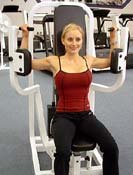
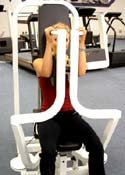
Pec Flyes (Butterfly).
Perfect For Isolating The Chest Before Moving
Into A Compound Exercise..
Don't Completely Fatigue

One consideration with this training method however is that you must be sure not to completely fatigue your muscles on the first isolated exercise. If you do this, you won't have any strength and energy left to complete the more compound exercise and could set yourself up for injury.
Precaution

Precaution should also be taken as this is a more intense type of training and without proper program planning could lead to overtraining. For example, if you normally don't work your triceps with your chest, you need to ensure that you have sufficient rest after working your triceps before going to chest as the triceps are an assisting muscle to most chest exercises.
If your triceps are still not fully recovered from their previous workout, you will be digging yourself into a deeper hole since in most people, their chest muscles can lift much more weight than their tricep muscles, therefore pre-fatiguing the chest to a point where they are only as strong as your triceps, which have not fully recovered would be a very difficult task to achieve.

By RISHABH JAIN with

Jul 12, 2011

16 Tips to Triple Your Workout Effectiveness


.
You don’t want to spend long hours at the gym, but you want to get stronger, fitter, leaner, and just plain look good. It’s possible that you’re not getting the most out of your workout time.
It’s possible to get a super-effective workout in 30 minutes, and only do a few workouts a week, if you maximize your workouts.

Disclaimer: First, I’m not a certified trainer. These are tips I’ve read elsewhere that work well for me. Second, you should always get a doctor’s approval of any new workout plan. This plan is especially intense, so if you have a heart condition or other condition that might be affected by heavy exercise, you should definitely refrain from trying it until you’ve gotten checked out by a doctor.
And even if you have gotten checked out, or even if you don’t bother doing so, it’s still important to start out an exercise program slowly, until your body has the chance to adjust, or you will face burnout or injury.
Don’t dive right into this program — it’s designed for people who have already been working out but want to see better results, quicker, and spend less time doing it. Here’s how to do it.

1 Limit your workouts to 30-40 minutes.
Though the tendency of some people who really want to get a lot out of their workouts is to spend a lot of time at the gym, the truth is that after 30 or 40 minutes, the benefit isn’t as great. To go that long, you’d have to lower the intensity of the workout, and that means that you’re spending too much time working out. It’s better to work out at a higher intensity for a shorter amount of time.
2 High-intensity workouts.
 If you’re just starting out with exercise, it’s best to take it slow. If you’re running or cycling, for example, build up your endurance for at least a month before you get into anything more intense. That means going at a rate where you can easily talk without being out of breath. However, once you have that base of endurance, step up the intensity to step up the effectiveness of the workout.

3 Protein.
Many people don’t pay enough attention to getting the protein their muscles need to rebuild. If you don’t, you are going to get very little out of your workout, as both cardio and strength workouts require protein for building muscles. I recommend either whey or soy protein shakes.
4 Water.
Be sure to hydrate throughout the day. It takes a couple of hours for your body to absorb the water, so you can’t just drink right before exercise. Make it a habit to drink water regularly throughout the day
.
5 Carbs.
 Although the low-carb craze might say otherwise, carbs are our body’s main source of fuel. If you do intense workouts, you will need carbs, or you won’t have enough energy. If you do a shake, be sure to include carbs — or a banana is a great source of low fiber/high glycemic carbohydrates that you need for exercise.

6 Shake before and after workout.
 It’s best to take a protein/carb shake just before your workout and then just after. Taking it before your workout increases the flow of amino acids to your muscles during training, giving them the building blocks they need. After the workout, the shake stimulates muscle growth. Also take a small protein/carb meal 60-90 minutes after a workout — a meal replacement bar would work fine.

7 Slow lifting.
Many people contract their muscles slowly and then release more quickly. But if you lift slowly in both directions, you are maximizing each move. Lift and lower to a 5-second count in each direction.
8 Heavier weight.
 When you’re starting out, it’s best to start with lower weights so you can focus on good form. But once you’ve gotten your form down, it’s best to lift the heaviest weights you can lift while still keeping good form. Don’t sacrifice form for heavy weights — that is ineffective. But heavy weights, with good form, can give you better results in a shorter amount of time. Heavy weights are not just for those who want to bulk up — that’s a common misconception.

9 One set, to failure.
 Instead of doing 2-3 sets, as many people do, maximize your effectiveness by doing just one, with heavy weights, until you can no longer keep the proper form. Lifting to “failure” doesn’t mean that you should lift the last few times with a wobbly or inefficient form.
10 Compound exercises
. Instead of isolating your muscles with exercises such as the bicep curl, you can maximize the time you spend in a workout by doing exercises that work out multiple muscle groups at once. With just a few exercises, you could get a full-body workout. Another benefit is that your muscles are working together as they do in the real world, rather than alone. Some great compound exercises include squats, deadlifts, good mornings, lunges, pushups, bench presses, military presses, rows, pullups, dips, and more.

11 Balance lifting.
 Instead of having exercises where you’re sitting down or holding on to something or otherwise stabilized, it’s more effective to do them standing up, or on one leg, or on a Swiss exercise ball. These types of exercises force you to balance yourself while lifting, which brings your core muscles into play. This gives you a stronger overall body and allows you to lift more over time.

12 Pick a cardio exercise you enjoy.
It’s no fun to exercise if you hate it. And you won’t keep it up for very long. Pick something that’s fun — running, walking, swimming, biking, hiking, rowing, stairmaster, etc. After the initial phase when you’re getting used to exercise, you’ll start to have a blast and look forward to it.

13 Mix it up.
Don’t stick to the same workout routine for too long, or your body will adjust to the stress level and you won’t be getting an effective workout. For strength training, change your routine every few weeks. For cardio, it’s best to cross train rather than, say, to run every time.

14 Good form.
 For strength training especially, and swimming, form is very important, but it’s also important for other types of exercise. If you’re strength training, start with lighter weights so you can work on your form. It’s good to have an experienced spotter or trainer who knows good form to help you for the first month or so. Never sacrifice form for heavier weight. For swimming, you’ll need to get a coach to teach you form.

15Hills.
If you run or bike or walk for cardio, you’ll want to incorporate hills (after the first month or two of doing it at an easy pace on flat ground). These will make you stronger and make your limited workout time even more effective. Take them easy at first, but once you’re used to hills, you can get a good pace going. Either use a hilly route or do repeats on one hill.

16 Circuits.
One mistake that people make is to do multiple sets of the same exercise without rest between the sets. This doesn’t allow your muscles to recover and it’s a waste of your workout. But instead of doing a set, resting, and then doing your second set, it’s more effective to move on to multiple exercises in a circuit, so that you don’t rest between exercises but do rest each muscle group. This will give you a good cardio workout while you do your strength training.
The ideal workout plan
If you take all of these tips into account, the ideal plan would be to alternate 2-3 days of high-intensity strength training with 2-3 days of high-intensity cardio. You could get by with 4 days of exercise if you do them at high intensity.
The high-intensity strength training would be 30-40 minutes of circuit training, with no rest or little rest between exercises within a circuit, and a short rest between circuits if you do more than one. The circuit should work out your entire body, using compound exercises such as the squat, deadlift, pullups, good mornings, etc., and either standing or using a Swiss ball so that you are working out your core. You should use heavier weights, one set for each exercise, doing them slowly (5 second up, 5 seconds down), and to exhaustion, making sure to have good form on each exercise.
You would have a protein/carb shake before and after the workout, and a small meal of protein/carbs within 60-90 minutes of the workout. Water is also important for both types of workouts.
The high-intensity cardio would be something you enjoy doing. You would do interval training, at a rate where you couldn’t talk, with short rests in between intervals. On some workouts, you would incorporate hills.
Remember, these high-intensity workouts are not for people just starting out. You should build up an endurance base before doing the high-intensity cardio, and start the weights with lighter weights, stressing good form.

By RISHABH JAIN with

The dynamic contents of this blog is not viewed correctly through Internet Explorer,in order to view the dynamic contents of this blog avoid using Internet Explorer